
Healthcare delivery has evolved significantly over the past decade, with telehealth becoming a core component of modern care. While its rapid adoption during the COVID-19 pandemic highlighted its value, telehealth has expanded far beyond virtual consultations to support remote patient monitoring, care coordination, patient engagement, and clinical decision-making. Today, its true potential lies in creating connected care ecosystems by integrating Electronic Health Records (EHRs), clinical workflows, patient engagement platforms, and revenue cycle operations. This integrated approach enables healthcare organizations to deliver more efficient, coordinated, and patient-centered care.
Telehealth Growth: From Niche Service to Healthcare Essential
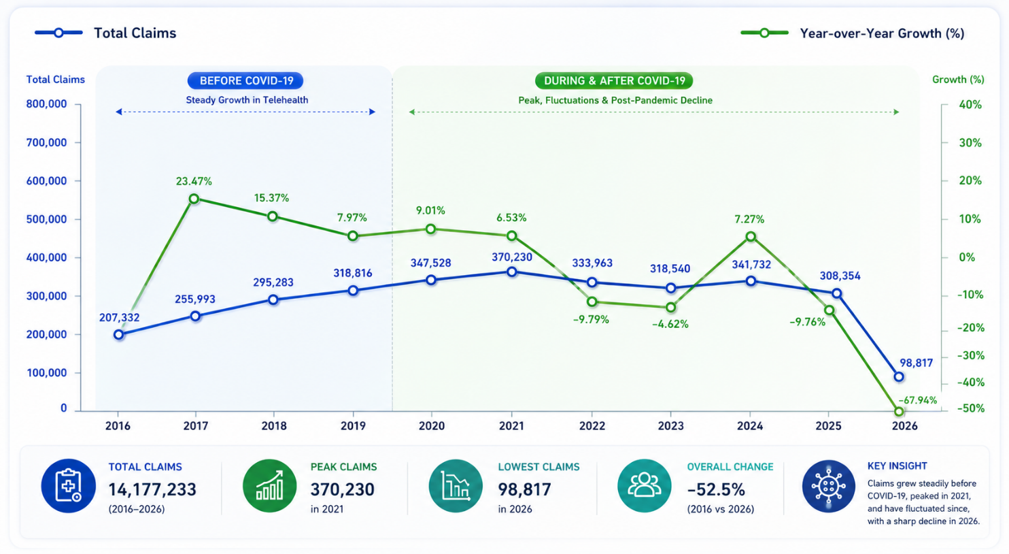
Telehealth’s growth began before COVID-19, but the pandemic significantly accelerated its adoption. Expedium’s billing data shows overall claims increasing steadily from 207,332 in 2016 to 318,816 in 2019, reflecting the gradual expansion of digital healthcare services. During the pandemic, claims peaked at 370,230 in 2021, highlighting telehealth’s critical role in ensuring uninterrupted patient care. Although claim volumes stabilized as in-person services resumed, telehealth remained a core component of healthcare delivery. Today, it supports greater patient access, care continuity, operational efficiency, making it an essential part of connected, technology healthcare.
Telehealth Has Evolved Beyond Video Appointments
Telehealth extends far beyond virtual consultations, encompassing services such as remote patient monitoring (RPM), chronic care management, behavioral health, secure messaging, virtual nursing, preventive care, post-discharge follow-ups, and care coordination. By enabling continuous patient engagement, it shifts healthcare from episodic treatment to proactive, patient-centered care, supporting earlier interventions, better chronic disease management, improved care continuity.
The Rise of Continuous Patient Care
One of telehealth’s greatest strengths is its ability to support continuous patient care through remote monitoring and real-time interventions. By enabling providers to track conditions such as hypertension, diabetes, heart failure, COPD, asthma, obesity, and behavioral health disorders between visits, telehealth promotes proactive, patient-centered care, improving outcomes and long-term disease management.
Why EHR Integration Determines Telehealth Success
As telehealth adoption grows, seamless Electronic Health Record (EHR) integration has become essential. Every virtual visit generates critical clinical information, including patient history, medications, treatment plans, and follow-up notes. Without integration, providers often face duplicate documentation, fragmented records, and inefficient workflows.
The Hidden Data Challenge Behind Telehealth Growth
Telehealth generates vast amounts of clinical data through remote monitoring devices, wearable technologies, patient messaging, and virtual care platforms. While this data improves clinical decision-making, it can also overwhelm providers if not managed effectively.
Clinicians often receive:
- Hundreds of patient-generated readings
- Automated alerts
- Follow-up messages
- Device notifications
- Care coordination updates
Improving Patient Engagement Through Digital Access
Telehealth improves patient engagement by making healthcare more accessible and convenient. It helps reduce missed appointments, improve treatment adherence, and encourage consistent follow-up by enabling patients to:
- Schedule appointments conveniently
- Connect with providers from home
- Receive electronic reminders
- Access educational resources
- Communicate securely with care teams
Telehealth and Health Equity: Opportunity and Responsibility
Telehealth has improved healthcare access by connecting patients with providers regardless of location, especially those in rural areas, individuals with mobility challenges, and busy professionals. However, equitable access still depends on overcoming barriers such as:
- Limited broadband access
- Technology affordability
- Digital literacy challenges
- Language barriers
- Accessibility for older adults
The Revenue Cycle Impact of Telehealth
As telehealth adoption grows, efficient revenue cycle management is essential. Virtual care requires accurate handling of:
- Payer-specific billing rules
- Modifier usage
- Place-of-service coding
- Documentation requirements
- Eligibility verification
Artificial Intelligence Is Reshaping Telehealth Workflows
Artificial Intelligence (AI) is making telehealth more efficient by reducing administrative tasks and enhancing clinical decision-making. Key applications include:
- Ambient clinical documentation
- AI-powered medical scribes
- Automated patient intake
- Predictive risk stratification
- Clinical decision support
- Intelligent appointment scheduling
Building a Sustainable Telehealth Strategy
Long-term telehealth success depends on building connected and scalable systems. Key priorities include:
- Integrated Infrastructure – Connect telehealth with EHRs, patient portals, scheduling, and revenue cycle systems.
- Standardized Workflows – Maintain consistent documentation and care processes.
- Strong Governance – Ensure privacy, security, and regulatory compliance.
- Financial Optimization – Align telehealth services with billing and reimbursement requirements.
- Data-Driven Decisions – Use analytics to enhance patient care and operational efficiency.
Telehealth’s Future Depends on Connected Systems
The next phase of telehealth growth will not be driven solely by virtual visit technology. Instead, success will depend on how effectively healthcare organizations connect telehealth with EHR systems, patient engagement platforms, clinical workflows, and revenue cycle operations.
Healthcare providers need more than video conferencing capabilities. They need integrated ecosystems that support clinical documentation, care coordination, coding accuracy, reimbursement optimization, and long-term scalability.
Organizations that align telehealth with EHR infrastructure and strong billing workflows are better positioned to improve patient outcomes, enhance provider productivity, and maintain sustainable financial performance.


Sneha Raj is a Digital Marketer at expEDIum with expertise in B2B marketing strategy, performance campaigns, and lead generation. She specializes in data-driven marketing, SEO, and paid advertising to help businesses drive measurable growth and build strong digital presence.