
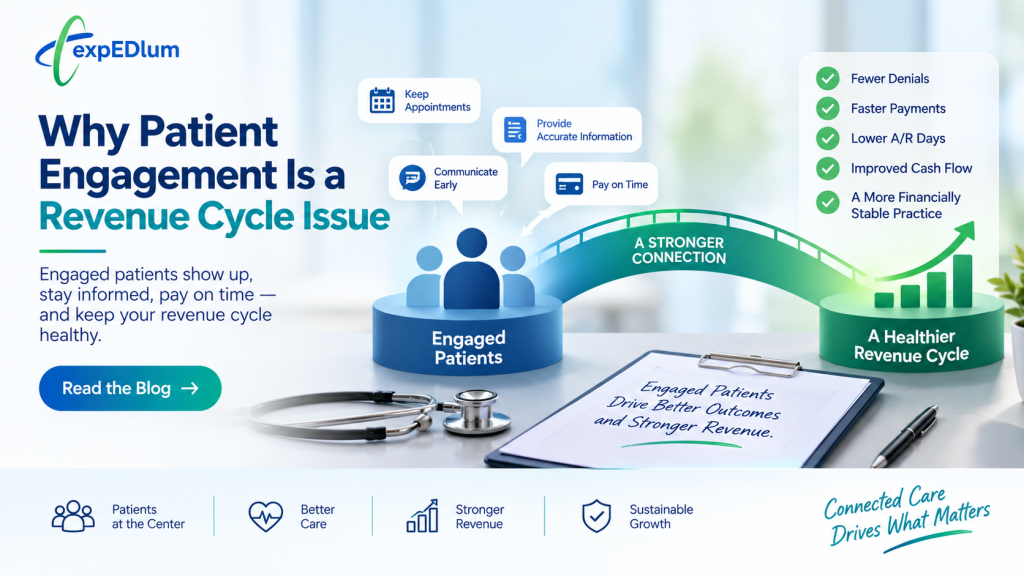
A patient can receive excellent clinical care and still create revenue cycle challenges for a healthcare organization. Missed appointments, incomplete registration forms, unverified insurance, unanswered billing messages, delayed payments, and confusion about statements can all slow down the flow of revenue. The common thread behind many of these problems is not necessarily the quality of care. It is how effectively the patient is engaged throughout the healthcare journey.
That is why patient engagement should no longer be viewed only as a care quality initiative. It also has a direct connection to revenue cycle performance. From appointment scheduling and eligibility verification to patient statements and collections, the way a practice communicates with patients can influence how quickly and accurately it gets paid. At expEDIum, we see patient engagement as an important part of creating a connected workflow between clinical operations and revenue cycle management.
What Does Patient Engagement Have to Do with the Revenue Cycle?
At first glance, patient engagement and revenue cycle management may seem like two separate functions. One focuses on communication and care, while the other focuses on billing, claims, and payments. In practice, they overlap at almost every stage.
Consider the patient journey. A patient receives an appointment reminder, completes registration, provides insurance information, point-of-service collections, payment plans, attends the visit, receives a statement, reviews their balance, and makes a payment. Each interaction provides information that can help or hinder the revenue cycle.
The Office of the National Coordinator for Health Information Technology reported that 65% of individuals nationally were offered and accessed their online medical records or patient portal in 2024. It also found that 87% of people encouraged by their healthcare provider to use their portal accessed it, compared with 57% who were not encouraged. These numbers show that communication and engagement can influence whether patients actually use digital healthcare tools.
How Patient Engagement Affects Revenue Cycle Performance
Patient engagement can influence revenue in several practical ways.
First, better engagement can improve the accuracy of registration and insurance information. When patients complete forms before an appointment and respond to requests for missing information, staff have a better opportunity to identify demographic or coverage issues before the claim is submitted. This matters because errors at the front end can eventually become rejected or denied claims.
Second, engagement can help reduce missed appointments. A reminder sent through a patient’s preferred communication channel can make it easier for the patient to confirm, cancel, or reschedule an appointment. That gives the practice an opportunity to use the appointment slot rather than simply losing the expected revenue.
Third, engagement matters after the claim has been processed. Patients may not understand why they owe a deductible, copayment, or coinsurance amount. A confusing statement can delay payment, while clear communication and convenient digital payment options can make the process easier. KFF’s recent research continues to show that healthcare costs remain a financial concern for many Americans, making clear communication particularly important. (KFF)
Patient Engagement and Patient Payments
One of the clearest connections between patient engagement and revenue cycle management is patient responsibility.
As insurance coverage becomes more complicated and patients face a larger share of healthcare costs, providers cannot simply send a statement and expect immediate payment. Patients need to understand what they owe, why they owe it, and how they can pay.
This is where digital engagement becomes useful. Secure online statements, payment links, reminders, two-way communication, and accessible financial information can reduce friction between the patient and the billing department.
CMS has also continued to emphasize patient access to healthcare information. In August 2026, CMS highlighted progress in expanding patient access to digital health tools and improving interoperability through its Health Technology Ecosystem initiative.
Why Patient Engagement Should Start Before the Visit
Revenue cycle teams sometimes focus heavily on what happens after the claim is submitted. However, many avoidable problems begin much earlier.
A connected patient engagement process can start with appointment scheduling and continue through registration, insurance verification, send appointment reminders, clinical communication, statements, , and payments. When these activities operate as disconnected processes, information can be duplicated or missed. When they are connected, staff have a clearer view of where the patient is within the administrative and financial journey.
For example, an automated reminder can encourage a patient to confirm an appointment. A digital registration process can collect updated demographic information. Insurance verification can happen before the encounter. After the visit, the patient can receive a statement electronically and access a convenient payment option. Each step removes a small amount of administrative friction.
What Should Healthcare Organizations Measure?
Healthcare organizations should not measure patient engagement only by portal logins or message volume. The more useful question is whether engagement improves operational and financial outcomes.
Practices can track appointment confirmation rates, no show rates, completion of digital registration, insurance information accuracy, statement delivery rates, payment conversion, days in patient A/R, outstanding balances, and response rates to billing communications.
These measures create a more complete picture. A patient who successfully completes registration, receives a timely statement, understands the balance, and pays electronically is not simply an engaged patient. That patient has also moved through multiple parts of the revenue cycle with less administrative intervention.
How Technology Connects Patient Engagement and RCM
Technology can make this connection easier, but simply adding another portal or messaging tool is not enough. ONC notes that patient portals need to be user friendly and integrated into clinical workflows if organizations want patients to actually use them.
At expEDIum, this is one reason our product ecosystem includes tools that connect patient communication with administrative and financial workflows. expEDIum Patient Connect supports appointment reminders, insurance verification, patient statements, and two-way communication, while expEDIum InstaPay provides an online option for patient payments. These capabilities are designed to support practical workflows rather than treat engagement as a separate activity.
The goal is not to automate every patient interaction. It is to make routine interactions easier for both patients and staff while allowing revenue cycle teams to spend more time on issues that actually need human attention.
The Bottom Line
Patient engagement is now part of the revenue cycle because the financial outcome of a healthcare encounter depends on much more than submitting a clean claim. Accurate information, completed forms, attended appointments, understandable statements, timely communication, and convenient payment options all contribute to getting paid efficiently.
The strongest healthcare organizations will therefore look at engagement across the entire patient journey, not just as a measure of patient satisfaction. When clinical, administrative, communication, and billing workflows work together, patients have a clearer experience and revenue cycle teams have fewer obstacles to manage.
For expEDIum, that connection is central to the broader role of healthcare technology. Combining EHR, patient engagement, medical billing, payment, and RCM capabilities can help practices build a workflow in which patient experience and financial performance support each other rather than operate in separate silos.


