
Picture this: your billing team submits a batch of claims on Monday. By Friday, many claims bounce back with denial codes, missing modifiers, or eligibility mismatches. Someone must pause their current task to locate the error. They fix it and resend, while the payment stays in limbo for weeks. Multiply that across hundreds of monthly claims. The consequence is clear: many administrators juggle billing and claims recovery.
This is exactly the kind of drag that first-pass acceptance rate is meant to measure and prevent. It is one of the clearest signals of how healthy a practice’s revenue cycle actually is, since it tells you how much reimbursement is arriving on time versus getting stuck in rework. This post covers what first-pass acceptance rate really means, why it deserves more attention, what tends to drag it down, and what practical steps move the number in the right direction.
What Is First-Pass Acceptance Rate in Medical Billing?
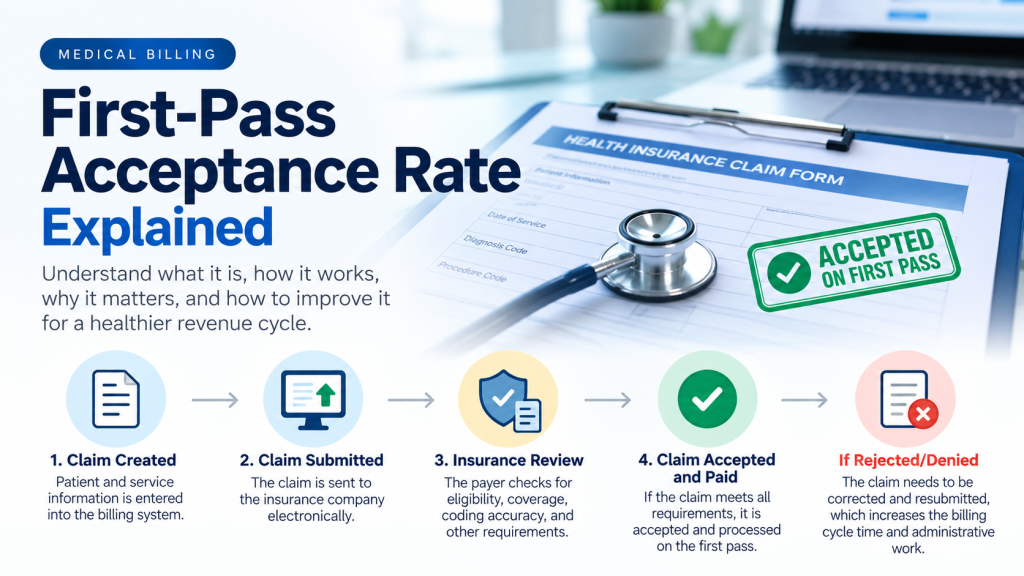
First-pass acceptance rate is the percentage of claims a payer accepts and processes on the very first submission, with no correction, re-submission, or manual intervention needed. If you send out 100 claims and 88 go through cleanly, your first-pass acceptance rate for that batch is 88 percent. It differs from a claims acceptance rate calculated across all submissions, including ones fixed and resent, because that broader number can look healthy even when the front end is generating a lot of avoidable errors.
Think of it as a quality control checkpoint. A claim can eventually get paid, but if it took three tries to get there, the practice already lost time, staff hours, and a chunk of cash flow along the way.
Why First-Pass Acceptance Rate Matters for Practice Revenue
A low first-pass acceptance rate is rarely just a billing inconvenience. It shows up as slower payments, higher administrative costs, and staff who spend more time chasing denials than handling new claims. According to Tebra’s 2026 Medical Billing Benchmark Report, the median first-pass acceptance rate across 190 billing companies sits at 85 percent, with less than half of firms reaching 90 percent or higher. The same report notes that nearly half of billing companies saw denial rates increase over the past year, up sharply from 2024, with many pointing to payers relying on more automated review. That shift means the margin for error on the provider side keeps shrinking.
For practice administrators and billing company owners, this translates into forecasting problems. When first-pass acceptance rate is inconsistent, projecting monthly collections becomes guesswork, making it harder to plan staffing, budgets, and growth. This is why so many RCM teams, including ours at expEDIum, track first-pass acceptance rate as closely as collections themselves.
Common Reasons First-Pass Acceptance Rate Drops
Most rejected claims are not failing because of complicated clinical disputes. They fail because of preventable, front-end problems, including:
- Incomplete or outdated eligibility verification
- Coding errors, mismatched CPT and ICD-10 pairings, or missing modifiers
- Missing prior authorizations and referral issues.
- Data entry mistakes in demographics or insurance details
- Documentation that does not clearly support medical necessity
None of these require a policy overhaul to fix. They require tighter processes at intake and coding, which is often where practices get the most value for the least disruption.
How to Calculate Your First-Pass Acceptance Rate
The formula is straightforward: divide claims accepted on first submission by total claims submitted, then multiply by 100. Run this monthly, broken down by payer and provider where possible, since a practice-wide average can hide one payer or coding pattern dragging the number down.
Proven Ways to Improve First-Pass Acceptance Rate
Improving first-pass acceptance rate is less about one fix and more about tightening several small links in the chain:
- Verify eligibility before the visit, not after. Real-time eligibility checks catch coverage gaps before a claim is even built.
- Use claim scrubbing before submission. Automated scrubbing flags coding mismatches, missing modifiers, and formatting errors before they reach the payer. This is one area where a billing partner like expEDIum, which builds claim scrubbing directly into its RCM workflow, can catch errors manual review often misses.
- Standardize documentation habits. Clear, consistent notes that support medical necessity reduce a common cause of rejection.
- Track denials by category. A monthly breakdown shows whether the problem is coding, eligibility, or authorization, so fixes can target the actual cause.
- Keep staff current on payer-rule changes. Requirements shift often, and a team even a few months behind will keep resubmitting the same avoidable errors.
- Consider outsourcing for complex payer mixes. Practices with varied specialties, such as FQHCs, often see rates improve once billing moves to a team, like expEDIum’s, that handles those payer nuances daily.
Most practices see measurable improvement within one or two billing cycles just from tighter eligibility checks and a scrubbing step before submission.
Frequently Asked Questions
What is a good first-pass acceptance rate? Most billing professionals consider 90 percent or higher solid, with top performers reaching 95 percent or above.
How is it different from a clean claim rate? Clean claim rate measures claims free of formatting or data errors at submission, while first-pass acceptance rate measures whether the payer actually accepted and processed the claim. A claim can be technically clean and still get denied for medical necessity or authorization reasons.
Can outsourcing billing actually improve this number? Often, yes. A dedicated billing team working with your specialty’s payer rules daily tends to catch errors an in-house team juggling multiple duties might miss.
How often should a practice review this metric? Monthly at a minimum, with a quarterly deeper review by payer and provider to catch creeping trends early.


Sneha Raj is a Digital Marketer at expEDIum with expertise in B2B marketing strategy, performance campaigns, and lead generation. She specializes in data-driven marketing, SEO, and paid advertising to help businesses drive measurable growth and build strong digital presence.