
It is 3:15 on a Tuesday. The provider just finished charting a visit, and the next patient is already in the exam room. Down the hall, a biller is retyping the same diagnosis, procedure, and insurance details into a second system, hoping nothing gets lost along the way. Most practice administrators know this scene well. It never looks like a crisis, but it quietly eats hours every week and sends claims back for reasons that were preventable.
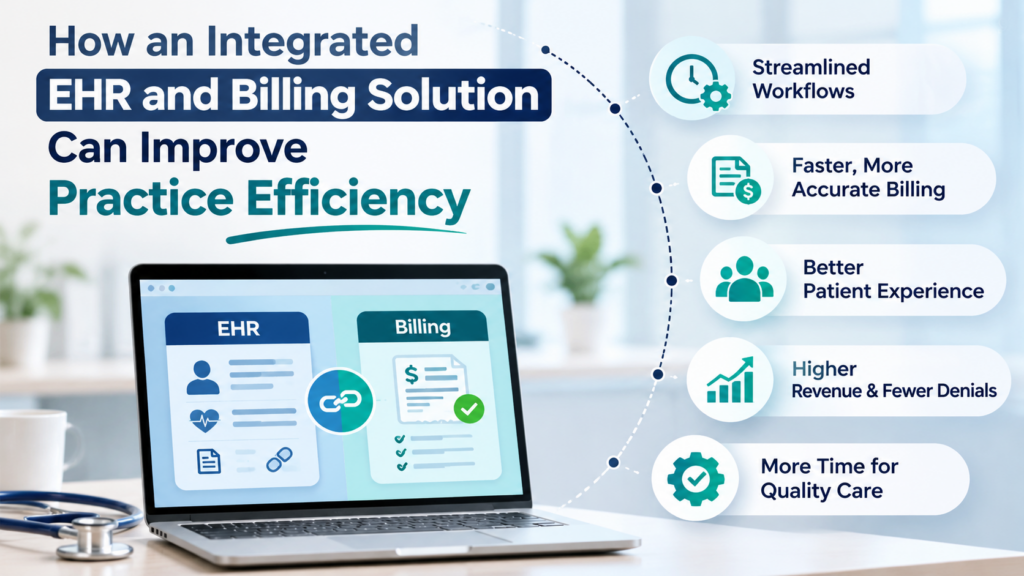
An integrated EHR and billing solution goes after that problem at the source by keeping clinical and financial information in one place. At expEDIum, we talk with practices about this question often, so in this post we will walk through what integration actually means, where the time and money savings come from, what current denial data says, and how to judge whether it fits your practice.
What Is an Integrated EHR and Billing Solution?
An integrated EHR and billing solution connects the electronic health record, where clinicians document care, with the practice management tools that handle scheduling, claims, and payments. The strongest versions run on a single shared database. That means the diagnosis a provider enters is the very same one the biller sees, with no export, import, or retyping in between.
This is different from two separate programs joined by an interface. Interfaces can work, but they add delay, and when one side changes, the other often lags behind. A truly unified setup removes that gap.
Where an Integrated EHR and Billing Solution Saves Time
Most of the savings come from small, repeated tasks that simply stop happening. Staff enter patient demographics and insurance details once, at scheduling or check-in. Documented services flow straight into charges, so fewer billable items slip through unnoticed. Front desk staff can verify eligibility against the same record the provider will use. And nobody spends the morning switching between three logins to find one answer.
A physical therapy group profiled by Healthcare IT News shows how this plays out. The practice had been running its EHR, billing program, and appointment reminders as three separate systems. After consolidating onto one platform across its locations, its leaders reported better billing, stronger collections, and smoother daily work. The rollout took five months, which is a useful reminder that the payoff is real but not instant.
How an Integrated EHR and Billing Solution Helps With Claim Denials
Denials are where inefficiency turns into lost revenue. A recent analysis from Kodiak Solutions, reported by TechTarget, looked at data from 2,400 hospitals and 375,000 physicians. The initial denial rate fell to 10.63% in the first half of 2026, down from 12.00% a year earlier. That sounds like progress, but the same analysis found providers were not seeing revenue rise, and final denial rates for Medicare Advantage plans (3.76%) ran well above traditional Medicare (2.22%).
In plain terms, payers may deny less up front and still force practices to work hard to get paid. Physicians Practice noted in May 2026 that denial rates exceed 10% at many practices. The MGMA 2026 Regulatory Burden Report ranked Medicare Advantage denials, audits, and appeals among physicians’ top pain points.
Billing in the same system as the chart builds claims from documented care instead of memory or sticky notes. Missing fields can be flagged before submission. When a denial does arrive, the biller can open the clinical note directly instead of messaging the clinic and waiting for an answer. That shortens the appeal cycle, which matters because appeals are time sensitive.
Can an Integrated EHR and Billing Solution Reduce Clinician Workload?
Partly, and it helps to be honest about that. A national survey from the American Medical Informatics Association, covered by Healthcare Innovation, drew 1,253 responses. More than 77% said they finished work later than they wanted or took work home because of EHR documentation, and about 74% said documentation time gets in the way of patient care.
An integrated system will not write your notes for you. What it can do is remove the duplicate clerical work around them: fewer clarification questions from billing, fewer re-entered fields, and less hunting through separate screens. Clinicians will still need good templates and training for the notes themselves.
What to Look for in an Integrated EHR and Billing Solution
Not every product that carries the label is built the same way. A few questions can separate a genuine fit from a patched together one:
- Does it run on one database, or two systems stitched together?
- Are eligibility checks and claim scrubbing part of the normal workflow?
- Can your team run reports on denial reasons, days in A/R, and collections without a developer?
- Are patient payments and reminders tied to the same account?
- Does it suit your specialty and size, whether you are a behavioral health practice, an FQHC, or a billing company?
- Is there a realistic plan for data migration and staff training?
At expEDIum, we build EHR, billing, and patient communication tools to work from a shared record, so teams can see the clinical and financial sides of an encounter together. Whichever vendor you consider, ask for a demo that follows your own workflow instead of a generic script.
Final Thoughts on Choosing an Integrated EHR and Billing Solution
An integrated EHR and billing solution will not fix every revenue cycle problem, and it will not shrink documentation overnight. What it does well is remove the duplicate entry, the handoffs, and the guesswork that make everyday work slower than it needs to be. With denials still a pressure point for practices of every size, cleaner claims and faster follow up are worth planning for. Start by listing where your team retypes information today, then use that list to evaluate vendors. If you would like to see how this works in a live setting, the team at expEDIum can walk through a demo built around your workflow.


Sneha Raj is a Digital Marketer at expEDIum with expertise in B2B marketing strategy, performance campaigns, and lead generation. She specializes in data-driven marketing, SEO, and paid advertising to help businesses drive measurable growth and build strong digital presence.